Is Semrush accurate? Why your rank tracker and Search Console disagree in 2026
Short answer: Semrush is good for trends and competitor research, but its numbers are estimates, and since mid-September 2026 rank data from every tool that scrapes Google has been less reliable than usual. Semrush confirmed on 27 October that Google is returning “poisoned” results to automated rank trackers. For your own site, Google Search Console is the source of truth. Check it before you react to any sudden drop.
If your rank tracker showed a page falling off a cliff this autumn, and nothing else changed, you are not imagining it. Here is what happened, how accurate Semrush is in normal times, and a five-minute check that tells you whether a drop is real.
What happened: “poisoned” Google results
Rank trackers work by running searches automatically and recording who appears where. From around 13 September 2026, some of those automated searches started coming back with results pages that look normal but have most of the usual sites swapped out. There is no error page and no CAPTCHA, so the tools stored them as real rankings, and sites appeared to drop for no reason.
- Nozzle, a rank-tracking company, analysed 27.5 million results pages across 49 countries and found about 8% poisoned after 13 September, against 0.17% before. Most bad readings lasted a single check, and 77.9% recovered within three days.
- Semrush confirmed the problem on 27 October, called it industry-wide, said the effect on tracked rankings was limited and mostly beyond page one, and said it had added checks to detect and exclude invalid results.
- DataForSEO, which supplies data to many SEO tools, also says it is industry-wide rather than limited to one provider.
Google has not confirmed that it does this on purpose. The common explanation is that it is part of Google’s effort to limit automated scraping, which has grown fast with AI tools. Treat that as a likely reason, not a fact.
How accurate is Semrush normally?
Even before September, Semrush and similar tools were never a measurement of your site. They estimate. Organic traffic is modelled from the keywords a site ranks for, the search volume of those keywords and the share of clicks each position usually gets. That works well for spotting direction and comparing competitors, and less well for exact numbers on a small site:
- One UK agency compared Semrush with Search Console on 32 client sites and found it within 10% only twice.
- Independent reviews often find it close on some sites and well off on others, with a tendency to overestimate sites that already get a lot of organic traffic.
- New and small sites are the hardest case: the tool may not track the long-tail searches that actually bring you visitors.
We saw this on our own site. A third-party SEO audit reported “0 keywords ranking” for whichaisent.com, while our Search Console showed thousands of impressions and our homepage on page one for our brand name. Both were “true” in their own way, but only one was measured.
Search Console vs Semrush: which one to trust for what
| Question | Use |
|---|---|
| How many clicks and impressions did my site get from Google? | Search Console (measured) |
| What position do my pages actually show at for real searchers? | Search Console (average over real searches) |
| Did my page really drop this week? | Search Console first, then your tracker |
| Which keywords and backlinks do my competitors have? | Semrush or a similar tool (estimates) |
| Which keywords should I target next? | Both: Search Console for queries you already appear for, the tool for new ideas |
How to check whether a ranking drop is real (5 minutes)
- Open Search Console → Performance → Search results. Set the dates to the last 28 days and click Compare with the previous period.
- Filter by the page or query your tracker says dropped (Page or Query filter, “exact URL” or “contains”).
- Look at average position and clicks together. A real drop shows in both. If Search Console is flat while your tracker shows a fall, the tracker probably recorded a bad results page.
- Wait for the next tracker reading. Most poisoned readings in Nozzle’s data lasted a single check and recovered within three days, so a one-day cliff that bounces back is a strong sign of bad data.
- Check the country. The problem was much worse in some countries than others on the same day. If you track several markets, compare them before you panic.
Only change pages, titles or links after Search Console confirms the drop. Reacting to a phantom fall can do more harm than the fall itself.
The same lesson applies to AI search
Many AI visibility tools work the same way rank trackers do: they ask ChatGPT, Gemini or Perplexity a set of questions automatically and record whether you were named. That is useful, and we offer a free ChatGPT visibility check ourselves, but it is a sample. AI answers change from one run to the next, and an automated session is not always what a real person sees.
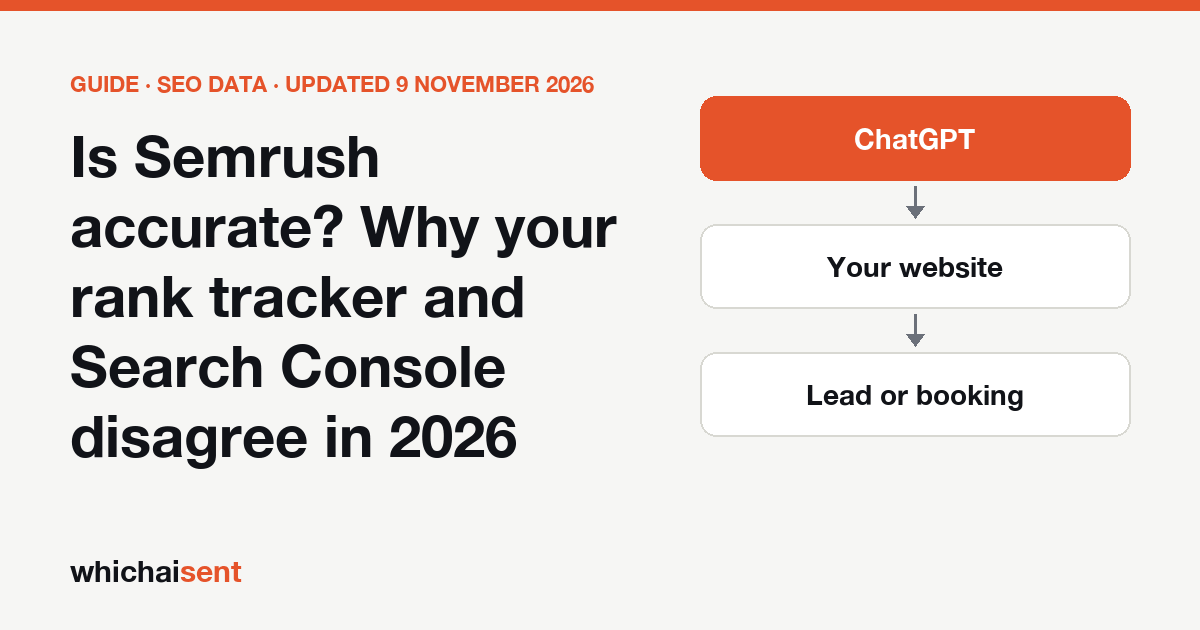
The measured result is what lands on your website: the visitors that ChatGPT, Gemini and Perplexity actually send, and which of them fill in a form, call or buy. That is first-party data, collected on your own site, so no scraping problem can distort it. It is also what AI search tracking should end with: mentions, then visits, then leads.
Related: Does ChatGPT use Google or Bing? · Why AI attribution undercounts · “How did you hear about us?” options
Sources
Semrush accuracy and poisoned results
Is Semrush accurate?
For trends and competitor comparisons it is useful, but its numbers are estimates, not measurements. Traffic is modelled from rankings, search volume and expected click-through rates, and one agency that checked 32 client sites found Semrush within 10% of Search Console only twice. Since mid-September 2026, rank data from every scraping tool has also been affected by “poisoned” Google results.
What are poisoned SERPs?
Google results pages that look normal to an automated rank tracker but have most of the usual sites swapped out. They return a normal response with no error or CAPTCHA, so tools record them as real rankings. Nozzle measured about 8% of results pages affected after 13 September 2026, against 0.17% before.
Should I trust Search Console or Semrush?
For your own site, Search Console. It reports the clicks, impressions and positions Google actually recorded for real searchers. Use Semrush for things Search Console cannot show, like competitors’ keywords and backlinks, and confirm any sudden drop in Search Console before acting on it.
Does this affect AI visibility tools too?
Any tool that collects answers automatically faces the same question: is what it saw what a real person saw? AI answers also change from one run to the next. Treat visibility scores as a sample and measure the visits and leads AI assistants actually send to your site as the result.
Measure AI search with your own data
See the visitors and leads ChatGPT, Gemini and Perplexity actually send your website. Free for one site.